
Duro changelog
Duro 2.0, the big release
Coming this January 5th; and now available for early access to our Integration partners — We are thrilled to announce Duro 2.0 — the most significant update in our platform's history. This release fundamentally reimagines how hardware teams collaborate, introducing enterprise-grade access controls, true multi-tenancy, and the foundation for a connected hardware engineering community.
These capabilities have been years in the making conceptually — ideas refined through countless customer conversations and deep reflection on where hardware collaboration needs to go. When we finally committed to building them, the result transforms Duro from a powerful PLM tool into a comprehensive platform for hardware collaboration.
What's New
Enterprise-Grade Role-Based Access Control (RBAC)
Introducing a comprehensive permission system that gives administrators complete control over who can do what across your organization.
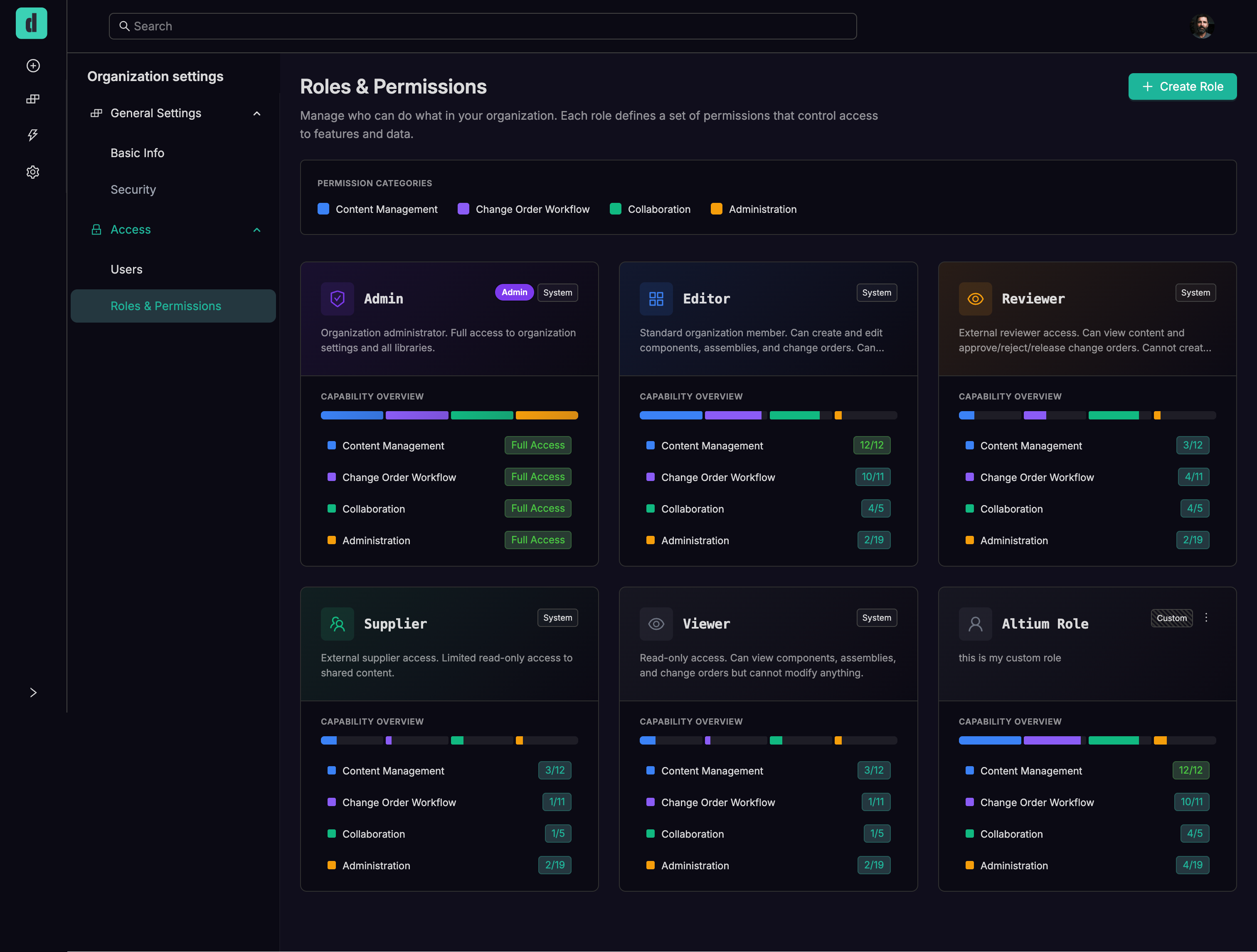
Our RBAC implementation follows a 2×2 matrix architecture combining scope (organization vs. library) and type (system vs. custom roles). With over 40+ individual permissions spanning Content Management, Change Order Workflow, Collaboration, and Administration, you can define access with surgical precision. The system uses hierarchical permission logic — granting delete access automatically enables read, update, and create permissions, reducing configuration complexity while maintaining security.
System Roles provide six pre-configured options designed for common organizational structures. Admin grants full organizational access including settings management. Editor enables creating, editing, and managing components and change orders. Reviewer allows approving, rejecting, and releasing change orders without edit capabilities — perfect for quality and compliance teams. Viewer provides read-only access, while Supplier offers limited external partner access to shared content.
Custom Roles let you build precisely the access model your organization requires. Create unlimited roles tailored to your workflows, starting from system role templates or building from scratch. Define exact permission sets for specialized team functions — ideal for compliance requirements, contractor access, or unique organizational structures.
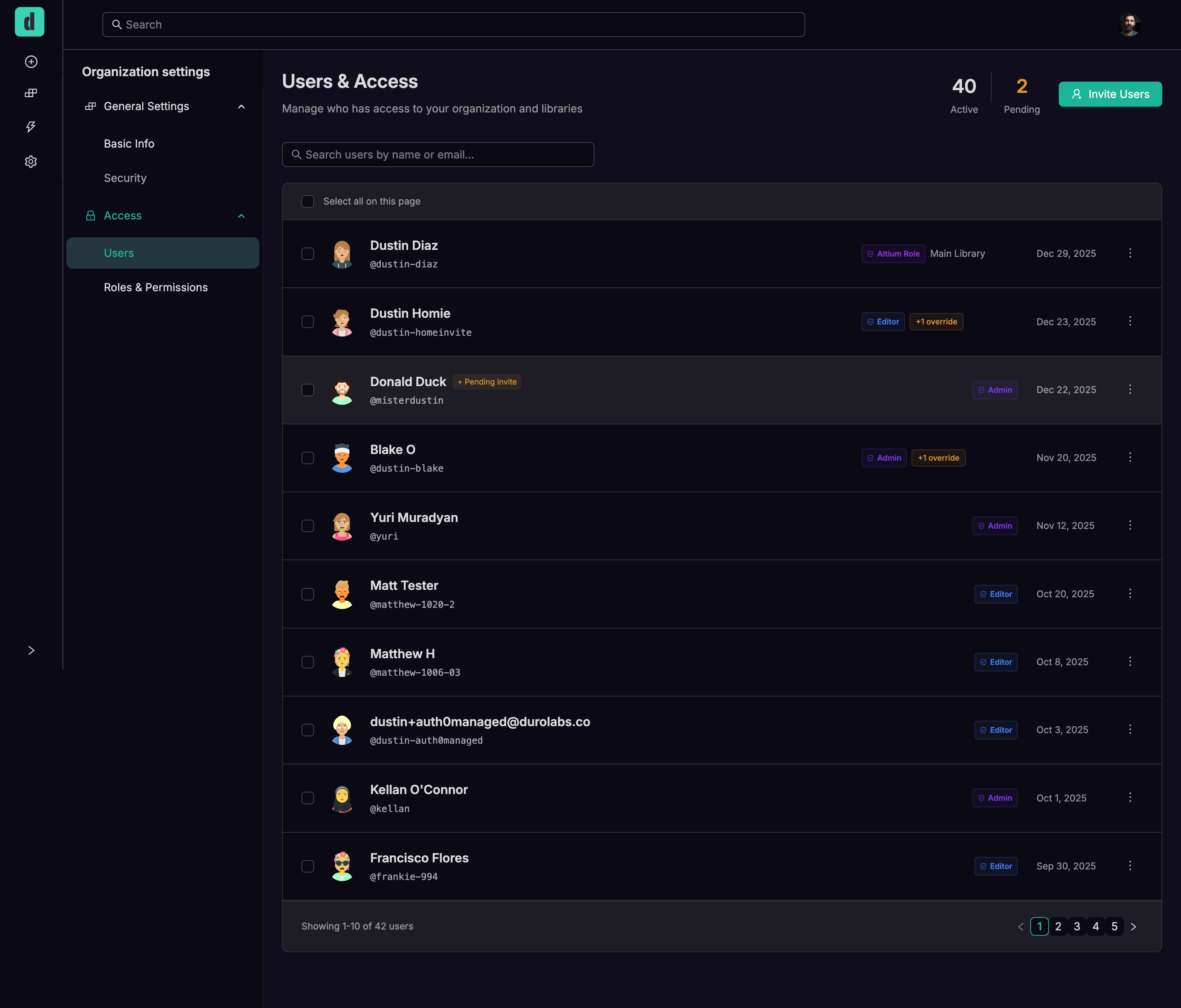
Library-Level Overrides add another dimension of control. Assign different roles per library for the same user, grant external partners access to specific libraries without organization-wide permissions, and rest assured that library-specific roles take precedence over organization roles. This enables precise access boundaries for multi-product organizations or those working with external collaborators.
For complete documentation, visit our RBAC Guide.
Multi-Organization & Multi-Library Architecture
Duro now supports true multi-tenancy, enabling users to work across organizations and libraries with distinct identities and permissions — much like you'd expect from GitHub or other modern collaboration platforms.
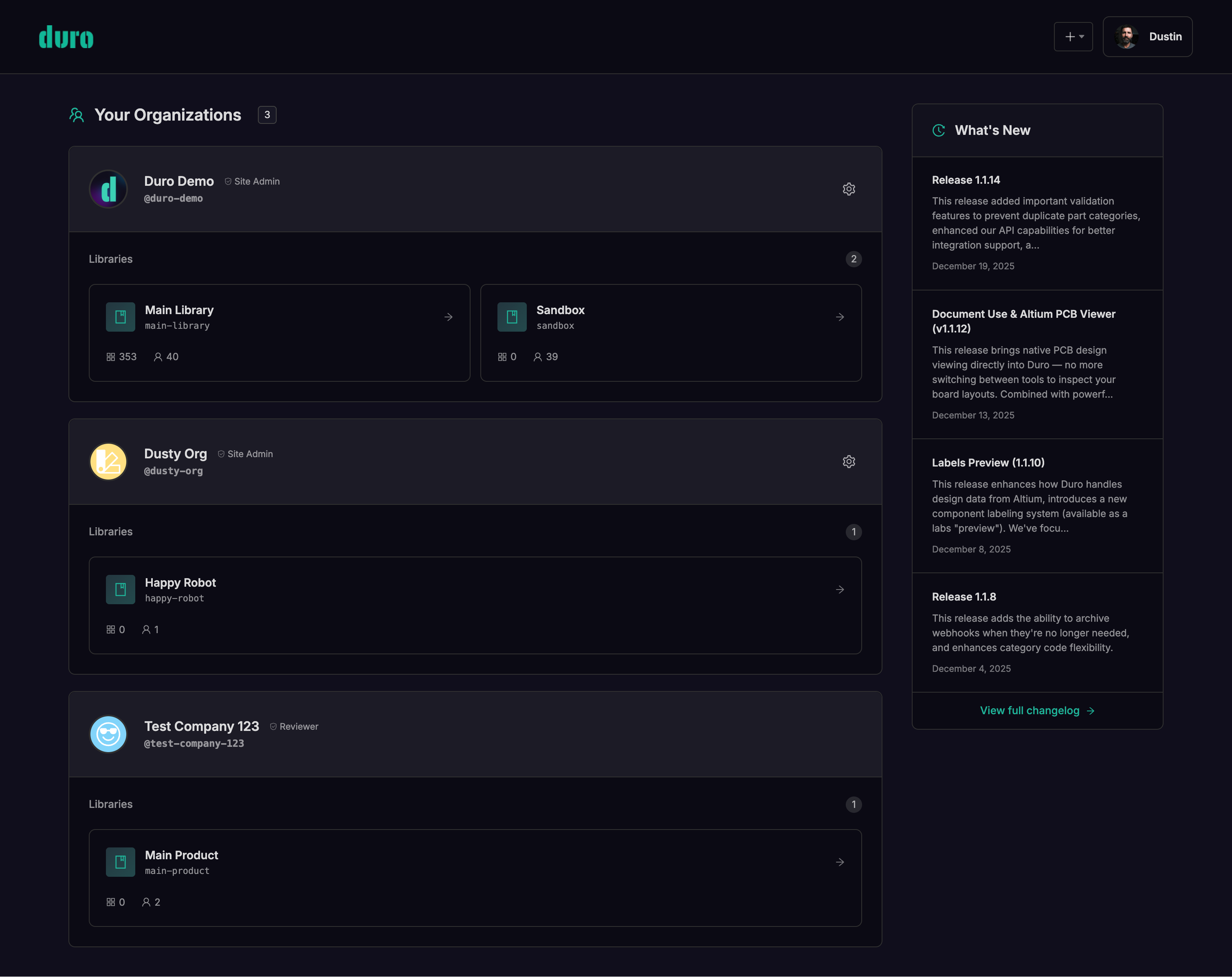
Your Duro identity is now truly yours. Maintain a single account across unlimited organizations, hold different roles in different contexts, and switch between them seamlessly. The redesigned home dashboard provides instant visibility into your entire Duro presence — every organization you belong to, your role in each, and quick-access cards to libraries complete with component counts and team sizes.
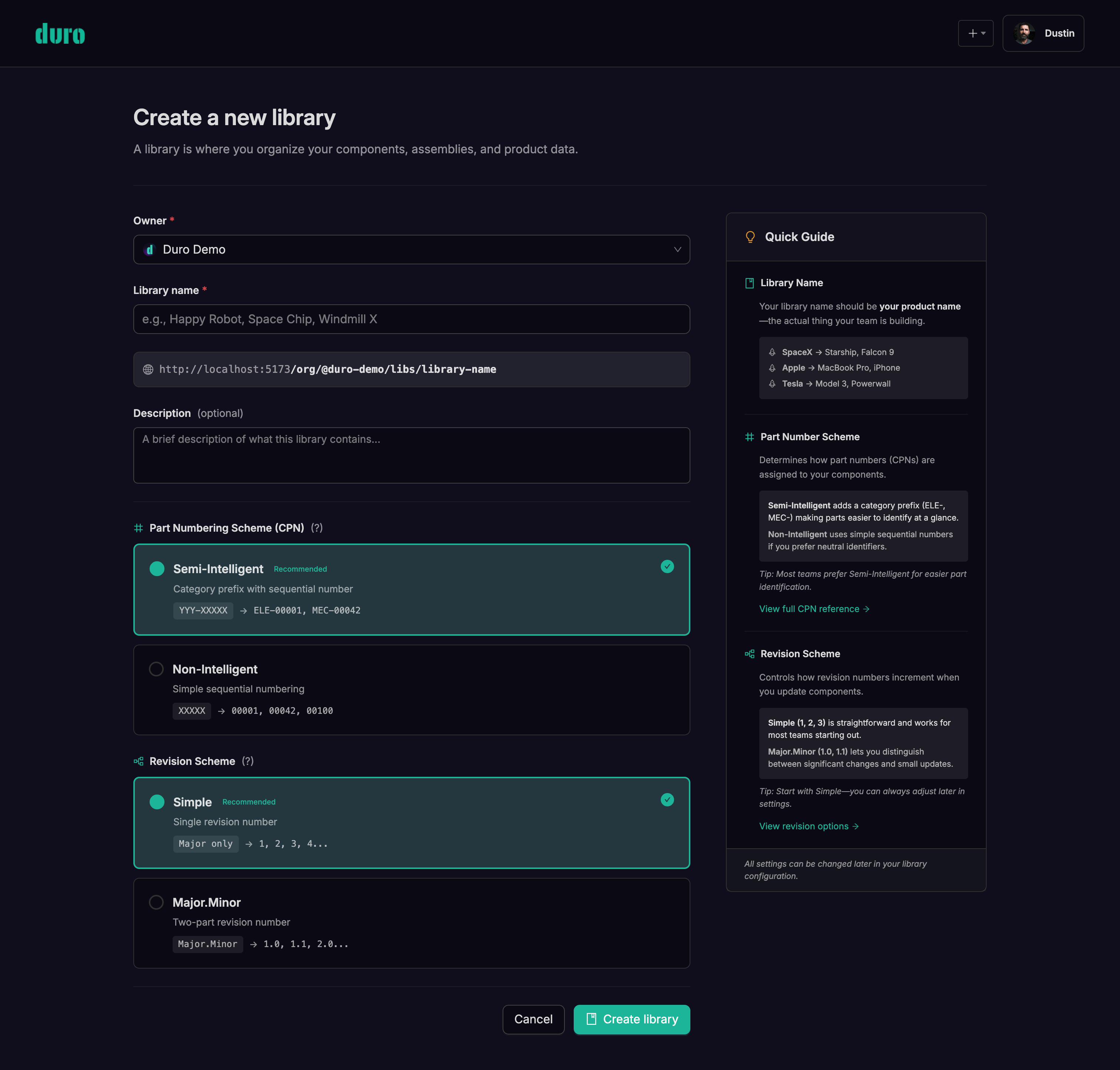
New guided workflows make expanding your footprint effortless. Create organizations with intuitive step-by-step wizards, spin up libraries with intelligent defaults, and configure part numbering schemes and revision strategies during setup — not after.

Organization & User Profiles
Every organization and user now has a permanent home on DuroHub. This is the foundation for something bigger — a connected hardware engineering community where discovery and collaboration extend beyond organizational boundaries.
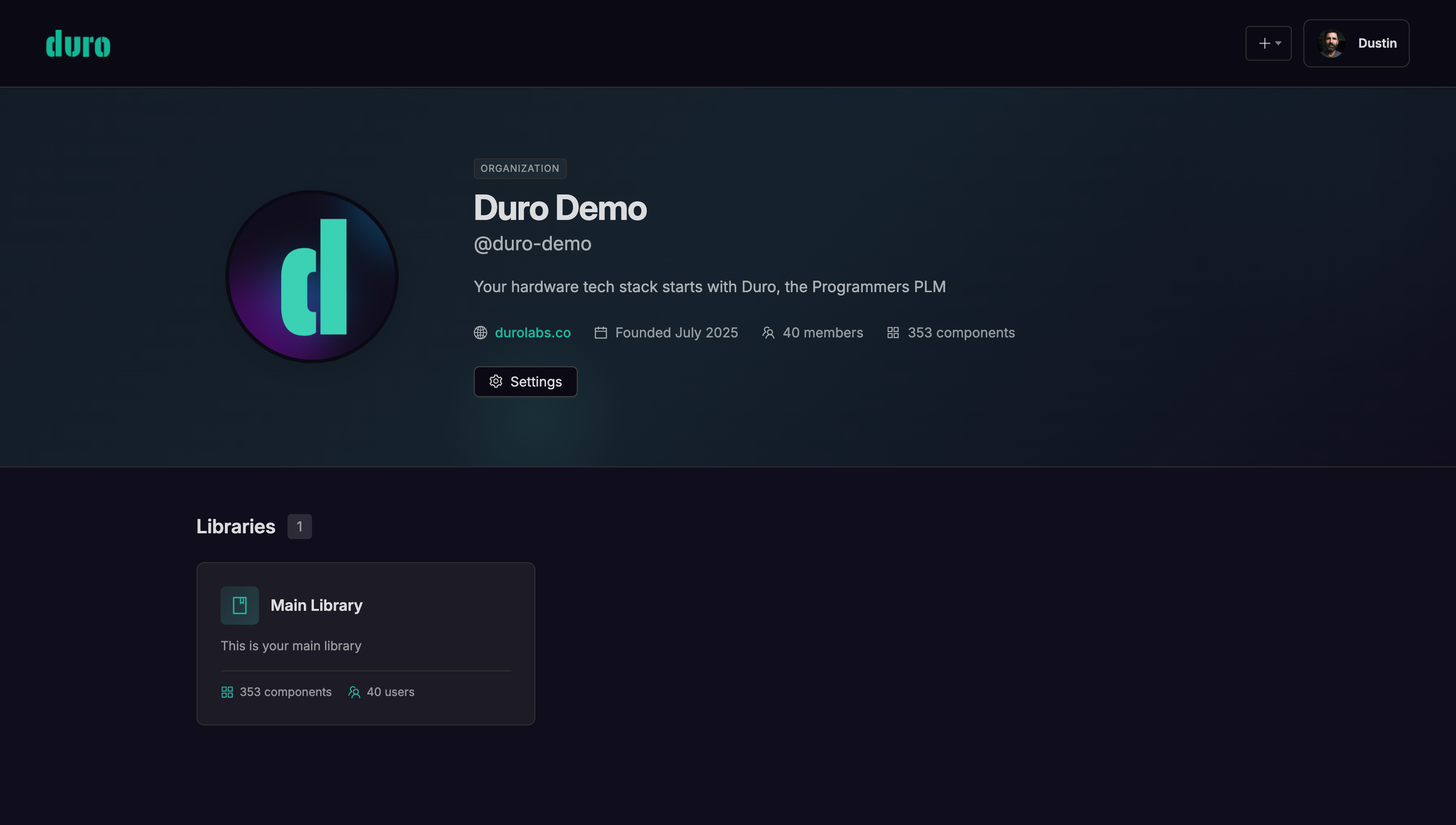
Organization Profiles live at durohub.com/org/@your-org. Showcase your organization with custom branding and descriptions, display key metrics like member count and component totals, and list libraries for visibility. It's your organization's public face on the platform.
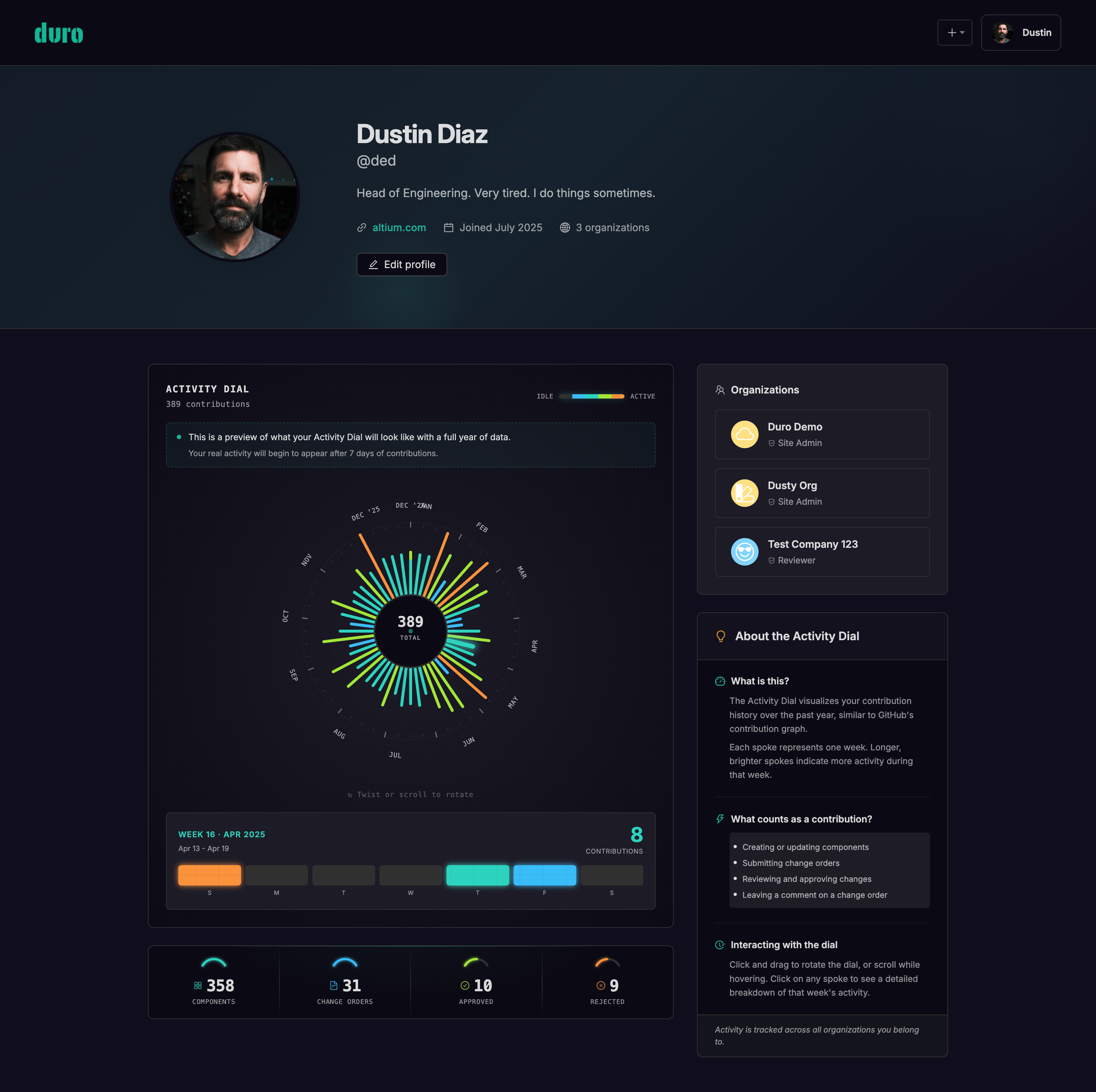
User Profiles at durohub.com/@username establish your professional identity in the hardware engineering community. The centerpiece is the Activity Dial — a radial contribution graph inspired by GitHub's contribution calendar, but with a hardware twist, visualizing your engineering activity over the past year. Each spoke represents a week; longer and brighter spokes indicate more activity. Click any spoke to see exactly what you accomplished.
Your profile tracks meaningful contributions: components created or updated, change orders submitted, reviews completed, and comments left. It's a living record of your impact across every organization you belong to.
Breaking Changes
This release includes API contract changes that may require updates to existing integrations:
Authentication model — User identity is now decoupled from organizations; API tokens must specify organizational context
Permission checks — All endpoints now enforce granular permissions; ensure API users have appropriate roles assigned
Multi-library queries — Responses now include library context; update parsing logic accordingly
Please review our API Migration Guide for detailed upgrade instructions.
Looking Ahead
Duro 2.0.0 establishes the architectural foundation for everything we're building next. Organization and user profiles are just the beginning — we envision a future where hardware engineers can discover, share, and collaborate on components across organizational boundaries, creating network effects that accelerate innovation across the industry.
This release represents an extraordinary effort from our team, and we're immensely proud to deliver it as we enter 2026. We extend our deepest gratitude to our customers whose feedback shaped every feature.
Here's to a transformative year ahead. We're just getting started.
— The Duro Team
Resources
Questions? Reach out to [email protected], Slack (if you’re connected), or your dedicated customer success manager.